The Electoral Bond Scheme
The Electoral Bond Scheme
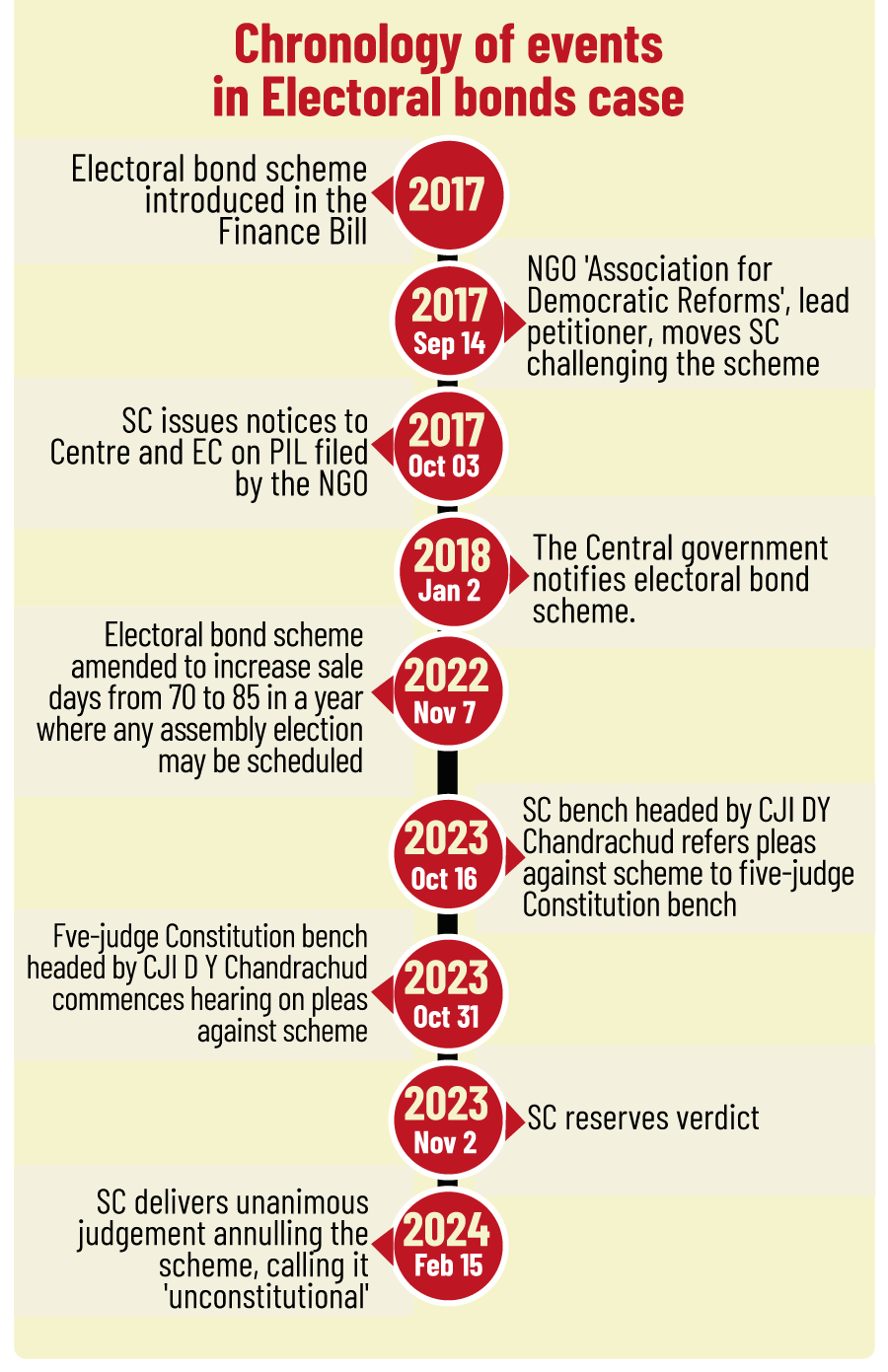
The Electoral Bond Scheme is a financial instrument introduced by the Government of India in 2018 to make political funding more transparent. Under this scheme, individuals and corporations can purchase bonds from specified branches of State Bank of India and donate them to political parties. These bonds are intended to make political donations traceable and reduce the use of cash in political funding.
However, there have been several criticisms and controversies surrounding the Electoral Bond Scheme:
Lack of Transparency: Critics argue that the scheme lacks transparency as the identity of the donor remains anonymous. Unlike earlier methods where donations above a certain threshold had to be declared, under the Electoral Bond Scheme, the anonymity of the donor is maintained.
Potential for Money Laundering: There are concerns that the scheme could be misused for money laundering purposes, as the anonymity of donors makes it difficult to trace the source of funds.
Unequal Access: Some political parties allege that the scheme gives an unfair advantage to the ruling party, as it potentially allows for large, undisclosed donations to be made to them.
Lack of Accountability: The lack of disclosure requirements for political parties receiving electoral bonds has raised questions about their accountability to the public.
Why did SC Strike Down the Electoral Bonds Scheme?
- Violation of the Right to Information:
- The court held that the scheme by permitting anonymous political donations infringed upon the fundamental right to information under ARTICLE 19(1)(A) of the Constitution.
- It pointed out that such a right is not only restricted to fulfilling the freedom of speech and expression but plays a key role in furthering participatory democracy by holding the government accountable. Thus, it is not just a means to an end but an end in itself.
- It highlighted that economic inequality leads to differing levels of political engagement because of the deep association between money and politics. As a result, there is a legitimate possibility that financial contribution to a political party would lead to quid pro quo arrangements.
- Not Proportionally Justified to Curb Black Money:
- Relying on the proportionality test laid down in its 2017 verdict in the KS PUTTASWAMY CASE which upheld the right to privacy, it underscored that the government did not adopt the least restrictive method to achieve its objective.
- As examples of such least restrictive methods, the Chief justice cited the ₹20,000 cap on anonymous donations and the concept of Electoral Trusts which facilitate the collection of political contributions from donors.
- The court also agreed with the contentions of the petitioners that since the purpose of curbing black money cannot be traced to any of the reasonable restrictions elucidated under Article19(2), it cannot be said to be a legitimate purpose for restricting the fundamental right to information.
- Relying on the proportionality test laid down in its 2017 verdict in the KS PUTTASWAMY CASE which upheld the right to privacy, it underscored that the government did not adopt the least restrictive method to achieve its objective.
- Right to Donor Privacy Does Not Extend to Contributions Made:
- The court pointed out that financial contributions to political parties are usually made for two reasons - as an expression of support and two, as a quid pro quo measure.
- However, it underscored that huge political contributions made by corporations and companies should not be treated at par with financial contributions made by another section of the population: a student, a daily wage worker, an artist, or a teacher.
- Thus, the Chief Justice held that the right to privacy of political affiliation does not extend to those contributions, which may be made to influence policies. It only extends to contributions made as a genuine form of political support.
- The court pointed out that financial contributions to political parties are usually made for two reasons - as an expression of support and two, as a quid pro quo measure.
- Unlimited Corporate Donations Violate Free and Fair Elections:
- The court found that the amendment made to Section 182 of the Companies Act 2013, permitting unlimited political contributions by companies, to be manifestly arbitrary.
- The provision allows Indian companies to make financial contributions to political parties under specific conditions. However, through the Finance Act, 2017, crucial changes were introduced including the removal of the prior cap on the amount that companies can donate to political parties - 7.5% of the average profits of the preceding three fiscal years.
- Additionally, the requirement for companies to disclose the names of the political parties to which contributions were made in their Profit and Loss (P&L) accounts was also eliminated.
- The Chief Justice highlighted that Section 182 errs by treating political contributions by individuals at par with those made by companies as the latter is often made with the intent of securing benefits in return.
- The court found that the amendment made to Section 182 of the Companies Act 2013, permitting unlimited political contributions by companies, to be manifestly arbitrary.
- Other Observations by SC:
- The SBI has been ordered to immediately stop the issuance of any further electoral bonds and furnish details of such bonds purchased by political parties since April 12, 2019, to the ECI by March 6, 2024.
- Such details must include the date of purchase of each bond, the name of the purchaser of the bond and the denomination of the bond purchased.
- The ECI shall subsequently publish all such information shared by the SBI on its official website by 13 March 2024.
- Electoral bonds that are within the validity period of fifteen days but have not yet been encashed by the political party will have to be returned following which the issuing bank will refund the amount to the purchaser’s account.
- The SBI has been ordered to immediately stop the issuance of any further electoral bonds and furnish details of such bonds purchased by political parties since April 12, 2019, to the ECI by March 6, 2024.
What were the Concerns Raised With Respect to Electoral Bonds?
- Contradicting its Basic Idea:
- The central criticism of the electoral bonds scheme is that it does the exact opposite of what it was meant to do i.e. to bring transparency to election funding.
- For example, critics argue that the anonymity of electoral bonds is only for the broader public and opposition parties.
- Possibility of Extortion:
- The fact that such bonds are sold via a government-owned bank (SBI) leaves the door open for the government to know exactly who is funding its opponents.
- This, in turn, allows the possibility for the government of the day to either extort money, especially from the big companies, or victimise them for not funding the ruling party - either way providing an unfair advantage to the party in power.
- A Blow to Democracy:
- Through an amendment to the Finance Act 2017, the Union government has exempted political parties from disclosing donations received through electoral bonds.
- This means the voters will not know which individual, company, or organization has funded which party, and to what extent. However, in a representative democracy, citizens cast their votes for the people who will represent them in Parliament.
- Compromising Right to Know:
- The Indian Supreme Court has long held that the “right to know”, especially in the context of elections, is an integral part of the right to freedom of expression under Article 19 of the Indian Constitution.
- Against Free & Fair Elections:
- Electoral bonds provide no details to the citizens. However, the said anonymity does not apply to the government of the day, which can always access the donor details by demanding the data from the SBI.
- This implies that the government in power can leverage this information and disrupt free and fair elections.
- Crony Capitalism:
- The electoral bonds scheme removes all pre-existing limits on political donations and effectively allows well-resourced corporations to fund elections subsequently paving the way for crony capitalism.
- Crony Capitalism: An economic system characterized by close, mutually advantageous relationships between business leaders and government officials.
- The electoral bonds scheme removes all pre-existing limits on political donations and effectively allows well-resourced corporations to fund elections subsequently paving the way for crony capitalism.
- Concerns Raised in Association for Democratic Reforms (ADR) Report, 2023:
- Analysis of Skewed Ratios of Donations and Funding Sources:
- The highest donations from Electoral Bonds, totaling Rs 3,438.8237 crore, were received in 2019-20, the year of the general elections.
- The year 2021-22, which witnessed 11 Assembly elections, saw donations worth Rs 2,664.2725 crore through Electoral Bonds.
- Out of the total donations of Rs 16,437.635 crore received by the 31 political parties analyzed, 55.90% came from Electoral Bonds, 28.07% from the corporate sector, and 16.03% from other sources.
- National and Regional Parties:
- National parties experienced a significant surge in Electoral Bond donations, witnessing a 743% increase between FY 2017-18 and FY 2021-22.
- In contrast, corporate donations to national parties increased by only 48% during the same period.
- Regional parties also witnessed a substantial proportion of their donations coming from Electoral Bonds.
- Power-Biased Donations of Electoral Bond:
- The party in power secured the highest donation among national political parties. More than 52% of the ruling party’s total donations were sourced from Electoral Bonds, amounting to Rs 5,271.9751 crore.
- Main Opposition party secured the second-highest Electoral Bond donations, with Rs 952.2955 crore (61.54% of its total donations), followed by the third largest party with Rs 767.8876 crore (93.27%).
- Analysis of Skewed Ratios of Donations and Funding Sources:

What are the Suggestions for Electoral Funding In India?
- Regulation of Donations:
- Some individuals or organisations, for instance, foreign citizens or companies, may be banned from making donations. There may also be donation limits, aimed at ensuring that a party is not captured by a few large donors — whether individuals, corporations, or civil society organisations.
- Some jurisdictions rely on contribution limits for regulating the influence of money in politics. US federal law imposes different contribution limits on different types of donors. Some other countries, such as the UK, do not impose contribution limits, but instead, rely on expenditure limits.
- Limits on Expenditure:
- Expenditure limits safeguard politics from a financial arms race. They relieve parties from the pressure of competing for money even before they start to compete for votes.
- Therefore, some jurisdictions impose an expenditure limit on political parties. For example, in the UK, political parties are not allowed to spend more than Euro 30,000 (about Rs 30 lakh) per seat.
- In the US, the Supreme Court’s expansive interpretation of the First Amendment (freedom of expression) has come in the way of legislative attempts at imposing expenditure limits.
- Providing Public Funding to Parties:
- The most commonly used method is to set predetermined criteria. For instance, in Germany, parties receive public funds on the basis of their importance within the political system.
- Generally, this is measured on the basis of the votes they received in past elections, membership fees, and the donations received from private sources. German “political party foundations” receive special state funding dedicated to their work as party-affiliated policy think tanks.
- A relatively recent experiment in public funding is that of “democracy vouchers”, which is used in local elections in Seattle, US. The government distributes a certain number of vouchers — each of which is worth a certain amount — to eligible voters.
- Voters can use these vouchers to donate to the candidate of their choice. The voucher is publicly funded, but the decision to allocate the money is the individual voter’s. Put simply, voters get to “vote” with their money before they cast their ballot.
- Disclosure Requirements:
- Disclosure as regulation rests on an assumption that the information supply and public scrutiny may influence politicians’ decisions and the electorate’s votes. However, mandatory disclosure of donations to parties is not always desirable.
- At times, donor anonymity serves a useful purpose of protecting donors. For instance, donors may face the fear of retribution or extortion by the parties in power. The threat of retaliation may, in turn, deter donors from donating money to parties of their liking.
- Many jurisdictions have struggled with striking an appropriate balance between the two legitimate concerns — transparency and anonymity. This issue was addressed by the Supreme Court in its judgment.
- The Chilean Experiment:
- Under the Chilean system of “reserved contributions”, donors could transfer to the Chilean Electoral Service the money they wished to donate to parties, and the Electoral Service would then forward the sum to the party without revealing the donor’s identity.
- If the complete anonymity system worked perfectly, the political party would not be able to ascertain the sum donated by any specific donor — and would find it extremely difficult to strike quid pro quo arrangements.
- However, it would be in the interest of donors (who want government patronage) and parties (who need money) to informally coordinate in advance to ascertain the sums donated by those donors. Indeed, as various scandals revealed in 2014-15, Chilean politicians and donors had coordinated with each other to effectively erode the system of complete anonymity.
- Balancing Transparency, Anonymity:
- One of the most prominent responses is to balance legitimate public interests in transparency and anonymity. Many jurisdictions strike this balance by allowing anonymity for small donors, while requiring disclosures of large donations.
- In the UK, a party needs to report donations received from a single source amounting to a total of more than Pounds 7,500 in a calendar year. The analogous limit in Germany is Euros 10,000.
- The argument in favour of this approach is: small donors are likely to be the least influential in the government and most vulnerable to partisan victimisation, while large donors are more likely to strike quid pro quo arrangements with parties.
- Establishing National Election Fund:
- Another option would be to establish a National Election Fund to which all donors could contribute. The funds could be allocated to parties based on their electoral performance. This would eliminate the so-called concern about donors’ reprisals.
- During the hearing, the apex court, however, flagged a new issue — the possibility of misuse of money received by political parties for activities like funding terror or violent protests, and asked the Centre whether it has any control on the end use.


Comments
Post a Comment